Jobs to Be Done: Financial Services
Explored the emotional and social factors behind Jobs-to-Be-Done to understand how user behavior and perception shape financial decision-making, uncovering opportunities to improve content and product strategy for a financial services client's digital tools.
- Team
- Lead UX Researcher (me), 1 UX Designer, and the client's branding and marketing team
- Methods
- Jobs-to-be-done interviews, Help Me statements, Journey mapping
- Timeline
- Q3 2024–Q1 2025
- Tools
- Figma, Condens, Respondent
Overview
At Terakeet, I led a Jobs-to-Be-Done study that shaped 25% of a large financial services client's content strategy for Q1 2025. Rather than track what people did inside their financial apps, the research went after why: the emotional and social pressures behind saving, transferring money, and adopting new financial tools. Working with a UX designer and the client's branding and marketing teams, I turned ten in-depth interviews into a set of "Help Me" statements and journey maps that gave the content team language rooted in real users instead of internal assumptions.
- Q1 2025 content strategy
- 25%Q1 2025 content strategy
- In-depth interviews
- 10In-depth interviews
- User segments studied
- 2User segments studied
The Problem
A large financial services client didn't have a clear picture of its primary user groups: what influenced their decisions to adopt financial products, what barriers stood in their way, or how to build the kind of brand confidence that would guide them through financial decisions. The client's existing user intent profiles described behavior at a surface level, who used which tools and how often, but not the emotional and social reasoning underneath those choices.
How might we understand the emotional and social jobs people were really hiring financial tools to do, so the client could speak directly to those needs instead of inferring them from behavioral data alone?
Scoping & Resourcing the Study
As the lead on this account, I was responsible for ensuring the team was appropriately resourced to deliver high-quality work. While directly leading a JTBD study, I simultaneously managed four UX researchers across two additional concurrent studies and supported ongoing research and design efforts for a separate healthcare client.
Multi-study resourcing schedule
Sam, Sammi, and Liz staffed the Financial Services engagement across AIO, UJM, and JTBD research. Tami split her time between a separate healthcare client account and Financial Services.
Given the complexity of the moderated research and overlapping team bandwidth constraints, including planned time off and the Thanksgiving holiday period, I developed a detailed week-by-week project plan to maintain momentum without overextending the team. Although initial timelines were scoped at one month, I used this plan to advocate for a more realistic delivery schedule, successfully negotiating an adjusted timeline with stakeholders.
To further optimize efficiency, I introduced AI-assisted analysis workflows, reducing synthesis time by approximately 50% while maintaining rigor and quality.
Process & Research
The study centered on ten participants split across the client's two existing user intent profiles: "Financially Focused Felix," older millennials focused on long-term stability, and "Optimizer Olivia," zillennials focused on debt payoff and day-to-day control. Participants were screened to use two or more financial apps and to have used a virtual card in the past six months, and anyone working in marketing, tech, design, or financial services was excluded to reduce bias.
Each session was an in-depth, one-on-one interview: I asked participants for a recent, real story in one of three topic areas, financial management, digital payments and transfers, and virtual cards and digital wallets, then followed up with open-ended questions like "What were you trying to accomplish?" and "How do you want others to perceive you when you're transferring money?" That structure surfaced the emotional texture behind financial decisions that survey data alone couldn't reach.
What We Heard
- Felix: "I want to build long-term financial stability and security for my family so that I can feel safe and confident when unexpected life events happen."
- Olivia: "I want to understand my progress toward becoming debt-free so that I can stay motivated until I achieve financial freedom."
- Both: "When unexpected expenses pop up, I want to adapt my budget quickly so that I can continue progress toward my financial goals."
“Accurate digital tools give me the freedom to enjoy the categories that I've allocated to have fun with. If I'm not keeping track accurately, I feel guilty and uncertain if I am going to have enough money.”
— Study participant, in-depth interview
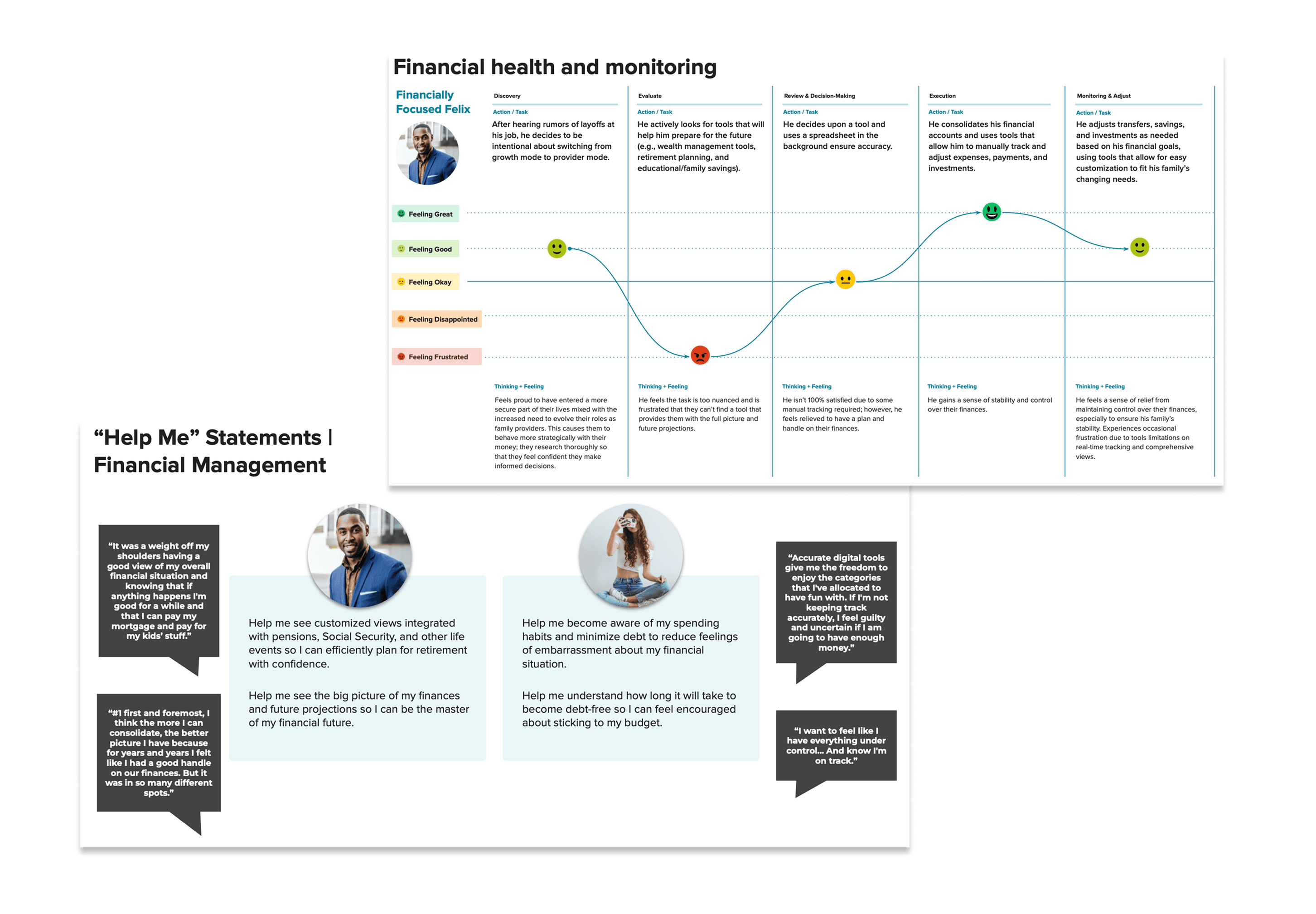
Interviews like these became "Help Me" statements: first-person expressions of what people needed a tool to do for them, used to build empathy internally and give the content and marketing teams language to write from. "Help me see the big picture of my finances and future projections so I can be the master of my financial future" and "Help me understand how long it will take to become debt-free so I can feel encouraged about sticking to my budget" became two of the most reused statements in later content planning.
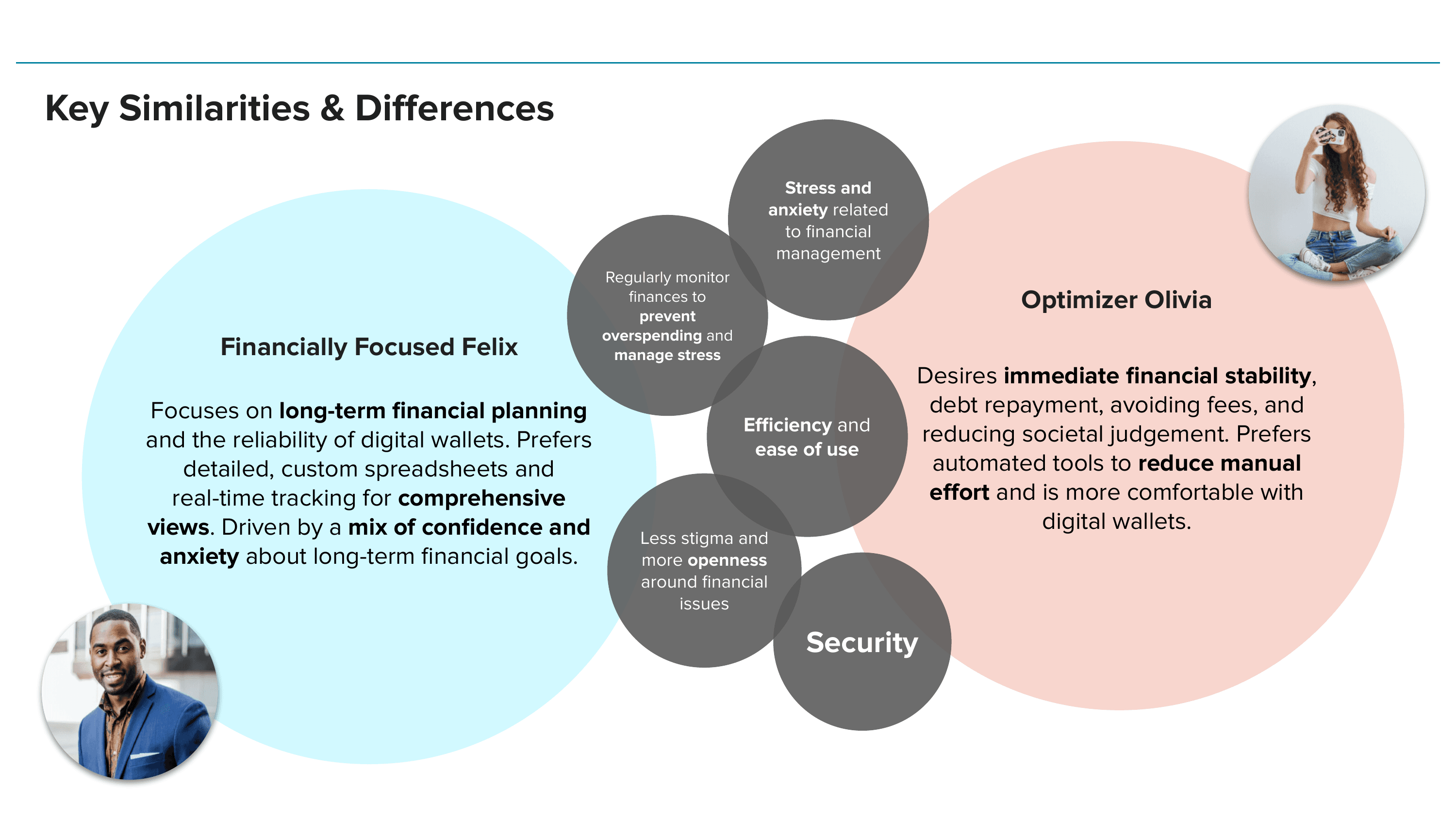
Security concerns showed up across both segments: Olivia wanted fraud alerts and confirmation before sending money, while Felix's version centered on transfer delays and lack of education on digital wallets, so I framed it as a shared, cross-segment priority instead of a single-persona footnote. The opportunities still diverged by persona: Olivia needed the client's tools reframed around stress relief and financial confidence tied to her debt-payoff timeline, while Felix needed comprehensive, real-time financial-health views that matched the spreadsheets he already built by hand, paired with content that normalized the anxiety of learning new tools.
How I Influenced the Team
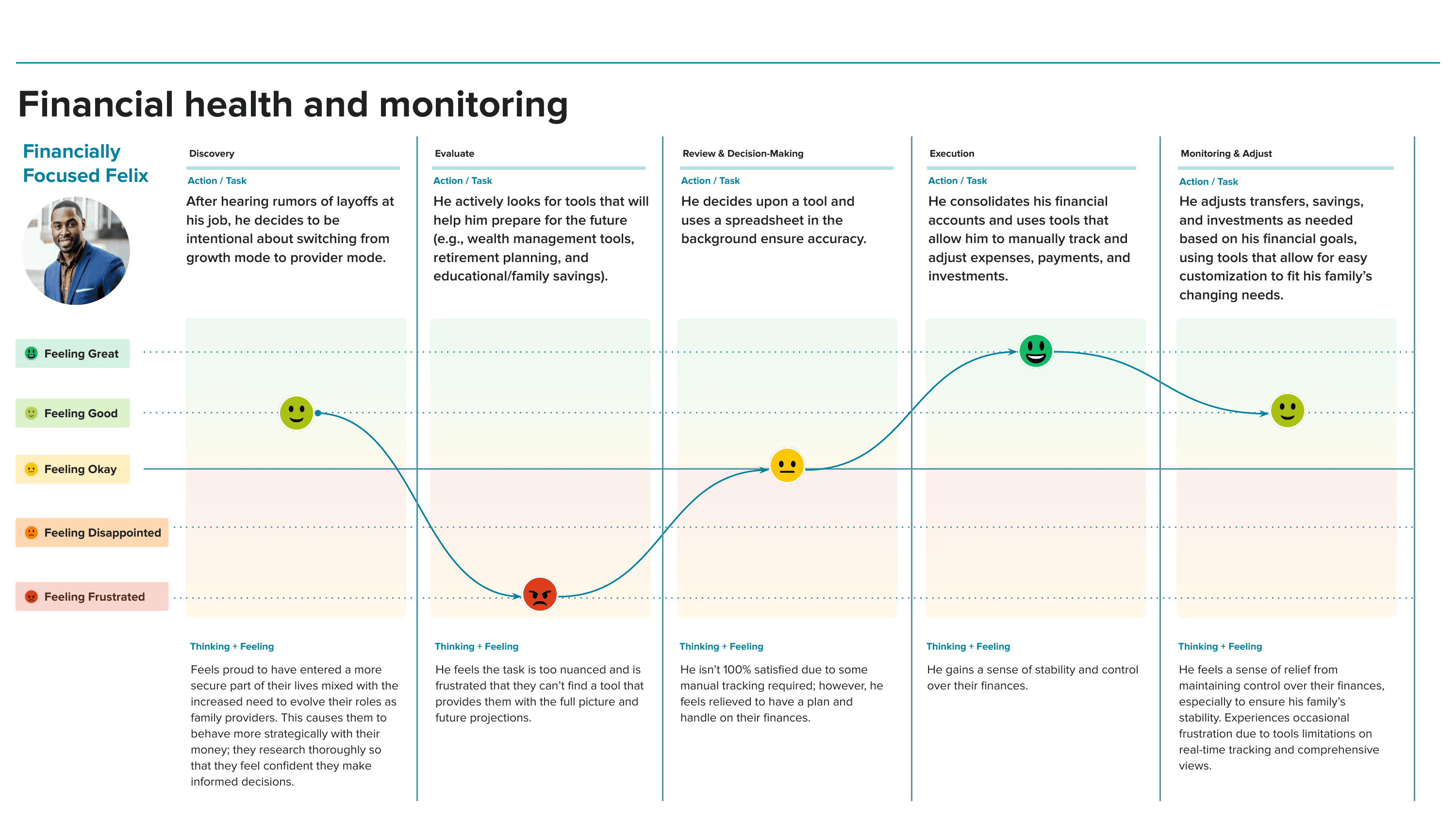
Rather than hand the client a slide of statistics, I leveraged direct participant quotes and full journey maps to make the research feel like real people, not an abstraction. The journey maps traced the emotional arc from discovery through monitoring for both personas across all three topic areas, so stakeholders could see exactly where frustration peaked and where confidence took over, using that emotional throughline to represent the larger user group rather than relying on a single, cherry-picked statement.
I worked directly with the client's content specialists and branding and marketing team to translate "Help Me" statements and Top Jobs into a list of concrete article topics they could act on immediately, which is what moved the findings from a research readout into an actual quarter of content production.
Outcomes & Impact
The research reshaped the client's content roadmap: 25% of the content team's strategy for Q1 2025 included article topics derived directly from the findings, including scams in digital transfers, the benefits of virtual cards, maintaining financial stability, and staying motivated with debt payoff plans.
The next step was optimizing the client's digital-tools landing pages to incorporate content built around users' own "Help Me" statements and Top Jobs, rather than internal product language, extending the research past content and into the product experience itself.
- 25% of the content team's Q1 2025 strategy derived from the research findings
- Shaped articles on digital-transfer scams, virtual card benefits, financial stability, and debt payoff motivation
- Set direction for optimizing digital-tools landing pages around real user language
- Leveraged AI within Condens to speed up synthesis by 50%
- Gave the content and marketing teams a reusable library of Help Me statements and Top Jobs